The Madison Season 1 Debut Review: Family Drama Unfolds in Montana
Warning: This review contains spoilers.
Taylor Sheridan continues to expand his television empire with The Madison, his latest drama series for Paramount+. Known for creating compelling Western narratives that attract both A-list talent and devoted audiences, Sheridan ventures into new territory with this grief-centered story that focuses primarily on female characters. While the show shares some DNA with his Yellowstone universe, it represents a notable shift from his typical contemporary Western formula. The premiere drops three episodes simultaneously, offering viewers substantial material to digest.
The opening episode establishes a stark dichotomy between urban chaos and natural tranquility. In Manhattan, Paige McIntosh (Elle Chapman) experiences a violent street mugging while walking down Fifth Avenue during a busy workday. A stranger assaults her and steals her shopping bags as bystanders record the incident rather than intervene. When police arrive, Paige struggles to provide a clear description of her attacker, concerned about potentially misidentifying someone.
The incident brings together the sophisticated Stacy Clyburn (Michelle Pfeiffer) with her injured daughter at a hospital, where Paige receives treatment for facial injuries requiring stitches. Stacy criticizes Paige for not using the family car service, leading to tension about safety and privilege. During a family dinner that evening, viewers meet the complete Clyburn clan: Paige’s husband Russell McIntosh (Patrick J. Adams), an investment banker; eldest daughter Abigail “Abby” Reese (Beau Garrett), a divorced mother; and her two daughters, Bridgette (Amiah Miller) and Alaina (Alaina Pollack). Notably absent is family patriarch Preston Clyburn (Kurt Russell).
Preston finds himself in Montana’s wilderness, celebrating his 64th birthday with brother Paul (Matthew Fox) through fly-fishing adventures. The brothers reflect on aging and mortality, with Preston acknowledging his limited time to enjoy physically demanding activities. Paul surprises Preston with plans to extend their trip by flying to an exclusive fishing location, despite Preston’s intention to return to New York.
Their scenic expedition takes a tragic turn when severe weather threatens their small aircraft. Paul struggles with takeoff as storm conditions deteriorate rapidly. The brothers attempt to navigate through dangerous cloud cover and turbulence, losing GPS functionality before encountering a mountain face-to-face. The scene cuts away ominously, foreshadowing the devastating news to come.
Stacy receives the life-changing phone call during breakfast with her close friend Liliana (Rebecca Spence). Forest Service officials inform her that Paul’s plane crashed in the Madison River valley with no apparent survivors. The department requires family member identification of the bodies. Stacy’s raw emotional response – screaming and sweeping dishes from the table – provides a powerful moment showcasing Pfeiffer’s dramatic abilities.
The family travels together to Montana for the grim task of body identification. Stacy initially refuses to view her husband’s remains, wanting to preserve her final memory of his smile and their goodbye kiss, but ultimately takes on the burden herself rather than allowing Abby to shoulder it. The aftermath shows both women processing the visual trauma of seeing their loved ones after such a violent accident.
At their hotel that evening, the grieving family gathers in Stacy’s room for comfort, watching A River Runs Through It, Preston’s beloved film about fishing and family bonds. Stacy reflects on her four-decade marriage, finding small solace in knowing Preston died pursuing his greatest passion. This intimate family moment establishes the show’s emotional foundation.
The following day brings the family to Paul’s Montana ranch property, featuring rustic cabins and stunning natural vistas. The entrance bears resemblance to Yellowstone‘s iconic ranch gates, though Paramount+ has clarified that The Madison operates independently from the Dutton family storyline. The property offers a more modest, authentic Western experience compared to Yellowstone‘s grand scale.
Stacy’s grief manifests in various forms as she processes Preston’s death while surrounded by his personal belongings and favorite spaces. The contrast between their luxurious Manhattan lifestyle – complete with pristine white interiors and expensive furnishings – and the rustic ranch environment highlights the cultural divide Preston navigated between his two worlds.
Despite challenging living conditions including shared outdoor facilities and limited amenities, Stacy decides the family will remain at the ranch. Her motivations include locating Preston’s chosen burial site marked on his personal maps and understanding her late husband through his journals and Montana experiences. She acknowledges her own mortality and the narrow window for making meaningful life decisions.
The second episode opens with flashback sequences showing Preston video-calling Stacy from Montana, sharing scenic photographs that fail to resonate with his self-described “beach girl” wife. These scenes establish how Kurt Russell will continue appearing despite his character’s early death, providing insight into the couple’s relationship dynamics through memory sequences.
City-versus-country comedy emerges when Paige encounters a hornet’s nest at the outdoor facilities, leading to chaotic insect control efforts. The family’s adjustment to rural living provides lighter moments amid the grief narrative, though Stacy proves most capable of handling practical challenges.
Local rancher Cade Harris (Kevin Zegers) introduces himself as a neighbor who knew both Paul and Preston, bringing food offerings to support the mourning family. An awkward exchange occurs when the granddaughters challenge Cade’s use of potentially offensive terminology, leading to family tension about respect and cultural sensitivity. Stacy’s harsh response to her granddaughters reveals her struggle to manage everyone’s grief processing methods.
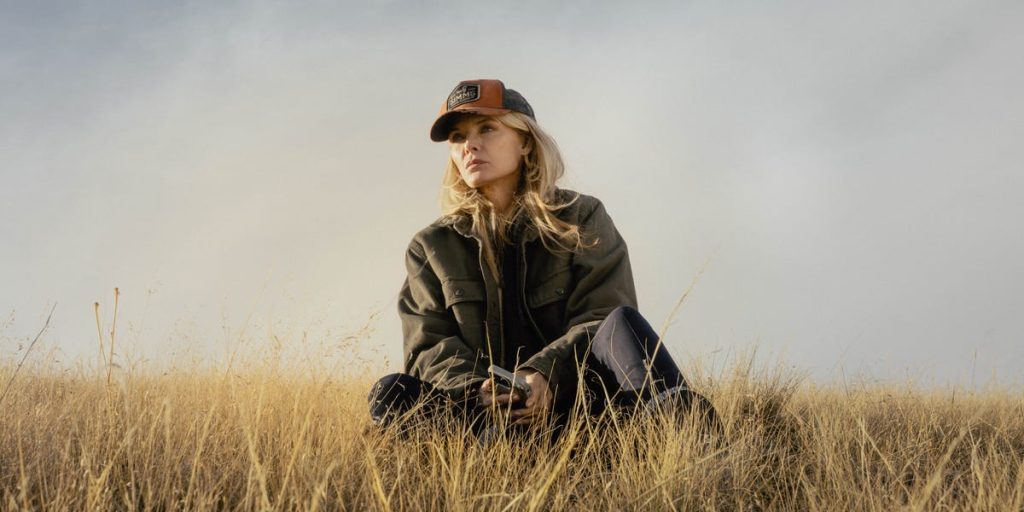
A poignant scene shows Stacy visiting horses in a nearby field, contemplating her emotional strength while leaning against one of the animals as sunset approaches. This beautifully filmed sequence, directed by Christina Alexandra Voros, captures the therapeutic connection between humans and nature that defines much of Sheridan’s work.
Through Preston’s journals, Stacy discovers detailed improvement plans for the ranch property designed to accommodate his family’s visits. The realization that these preparations were meant to bring his loved ones into his Montana world – but arrived too late for shared experiences – proves devastating. This discovery motivates Stacy’s decision to sell their Manhattan home and relocate permanently to Montana, both protecting the land and honoring Preston’s memory.
The third episode continues exploring family dynamics through flashbacks of Stacy and Preston discussing their daughter Abby’s marital separation and their appropriate level of involvement in adult children’s problems. These conversations reveal the couple’s journey from modest beginnings to substantial wealth.
A violent physical altercation erupts between Paige and Abby during breakfast, escalating from verbal disagreement to actual fighting with broken dishes. Stacy intervenes with water to separate them, demanding they show equivalent emotion about their father’s death. However, their fight likely represents grief manifestation rather than simple sibling rivalry.
Cade provides transportation for Stacy and Abby to retrieve Preston’s truck from local authorities, introducing them to his wife Kestrel (Danielle Vasinova) and arranging potential family connections. At the sheriff’s office, they meet Deputy Van (Ben Schnetzer), who appears close with Cade. Stacy discovers Preston’s handgun in the vehicle, triggering another wave of mourning as she sits in one of his final occupied spaces.
During the return drive, Stacy attempts persuading Abby to remain in Montana permanently, eventually threatening financial consequences if she refuses. The confrontation becomes heated enough that Abby exits the moving vehicle, forcing Stacy to drive away without her.
Cade intervenes by calling Van to assist the stranded Abby, while Stacy stops to examine Preston’s weapon. When Cade appears unexpectedly, he shares his family’s history with suicide, prompting Stacy to allow him to secure the gun temporarily. She also calls her New York friend Liliana, requesting immediate support during this crisis.
Meanwhile, Van and Abby develop instant romantic chemistry during their encounter, with the deputy providing emotional support through humor and music. Their connection intensifies quickly, culminating in a kiss observed by Abby’s daughters after Van drops her at the ranch.
The episode concludes with another flashback showing Preston and Stacy in their elegant Manhattan bathroom, discussing whether to financially support their struggling daughter. Preston’s inability to abandon Abby contrasts with Stacy’s current ultimatum, highlighting how grief may be altering her perspective on family loyalty.
The Madison represents a successful addition to Sheridan’s television portfolio, focusing on emotional depth rather than political messaging or complex plotting. Pfeiffer delivers an exceptional performance alongside strong supporting work from the entire cast. The six-episode format suits this intimate grief narrative perfectly, allowing for thoughtful character development within Montana’s spectacular natural setting. The series demonstrates Sheridan’s versatility in crafting compelling human drama beyond his typical Western action formulas.