The IBM Legacy Behind 80×24 and 80×25 Terminal Standards
The widespread adoption of 80×24 and 80×25 terminal displays stems directly from IBM’s market dominance rather than technological necessity. While the 80-character width clearly originates from IBM’s punch card format, the choice of 24 or 25 lines traces back to specific IBM terminal products that shaped industry standards through commercial success.
In 1971, IBM launched the 3270 terminal featuring an 80×24 display, which quickly became the market leader and established this format as the de facto standard. Competing manufacturers were forced to match IBM’s specifications to remain competitive. Later, the IBM PC introduced an 80×25 display in 1981, creating the parallel standard still used in PC environments today.
Debunking Technical Explanations
Various theories have attempted to explain the prevalence of these display dimensions through technical constraints such as television scan rates, memory limitations, or aspect ratios. However, examining the terminal market of the mid-1970s reveals dozens of different screen configurations, including 31×11, 42×24, 50×20, 81×38, and 133×64 formats.
This diversity demonstrates that technology did not dictate specific display dimensions. Instead, market consolidation around IBM’s standards occurred as the industry matured. By the early 1980s, most terminals had converged on 80×24, illustrating that commercial standardization, not technological limitations, drove the adoption of particular sizes.
Technical factors had minimal impact on terminal dimensions. While US television used 525 scan lines and 60 Hz refresh rates, 40% of terminals employed different specifications. Character generation varied widely in matrix sizes, and rapidly advancing DRAM technology meant memory constraints were temporary. Screen aspect ratios often differed significantly from text display ratios, proving these weren’t determining factors.
The Evolution of CRT Terminals
The CRT terminal market emerged from teleprinter replacement needs. Traditional teleprinters like the Teletype Model 33 printed 72-character lines on paper rolls and were widely used in newsrooms and computer systems throughout the 1970s. The transition to CRT displays represented a significant technological and economic shift.
By 1974, IBM controlled approximately 50% of the terminal market, with an additional 17% held by IBM-compatible manufacturers. This dominance effectively allowed IBM to define terminal characteristics across the industry. The market was segmented into teleprinter replacements, IBM 3270 terminals, programmable terminals, and graphics terminals.
The ASCII terminal market evolved from the teleprinter replacement sector and experienced rapid growth. By 1985, approximately 10 million CRT terminals were installed across the United States, representing a massive commercial success that transformed human-computer interaction.
IBM 2260: The Pioneer Display Terminal
IBM introduced the 2260 Display Station in 1965 as one of the first commercial video display terminals. This compact 45-pound unit was designed to fit standard office typewriter stands and served three primary functions: remote data entry replacing punch cards, database inquiry operations, and system console duties.
The 2260’s innovative design separated the display unit from the control logic, which resided in a massive 1,000-pound cabinet capable of supporting up to 24 terminals. This architecture used sonic delay lines for pixel storage, employing approximately 50 feet of coiled nickel wire to store sound pulses representing data bits.
The sonic delay line technology, while ingenious, had significant limitations including constant data refresh requirements, non-random access, vibration sensitivity, and temperature dependence. Despite these challenges, delay lines were much cheaper than core memory and well-suited to the serial nature of raster-scan displays.
The 2260 Model 3 displayed 12 lines of 80 characters, with the 80-character width designed for punch card compatibility. The 12-line limitation appears to have been determined by what the delay line technology could support without visible flicker, establishing a foundation for IBM’s later terminal developments.
IBM 3270: Market Domination
The IBM 3270 video display system, released in 1971, revolutionized the terminal market and established IBM’s dominance. Supporting both 40×12 displays for 2260 migration and larger 80×24 formats, the 3270 offered enhanced features including protected screen fields, improved communication efficiency, and variable-intensity text.
Technologically, the 3270 represented a significant advancement over the 2260, replacing vacuum tubes and transistors with hybrid SLT modules and substituting sonic delay lines with 480-bit MOS shift registers. The 80×24 display utilized four banks of shift registers totaling 1,920 characters, with the storage architecture based on 480-character blocks maintaining compatibility with the 2260.
IBM’s comprehensive software support for the 3270 proved crucial to its market success. This extensive ecosystem forced competitors to build 3270-compatible terminals to remain viable, effectively making 80×24 displays and 3270 compatibility industry standards. By 1977, IBM introduced the enhanced 3278 model supporting multiple line configurations, though the 80×24 format remained dominant.
The IBM PC and 80×25 Adoption
The prevalence of 80×25 displays in modern computing traces directly to the IBM PC’s introduction in 1981. The PC’s Monochrome Display Adapter (MDA) provided 80×25 monochrome text, while the Color Graphics Adapter (CGA) supported both 40×25 and 80×25 color modes, establishing this format as the PC standard.
The IBM PC’s design heavily influenced by the largely forgotten IBM DataMaster office computer, which shared many architectural elements including keyboard design, BASIC interpreter, Intel processors, and expansion bus configuration. However, the PC’s display capabilities exceeded the DataMaster’s 80×24 format.
The PC’s designers managed to achieve 320×200 pixel graphics modes, which when using 8×8 character matrices supported 40×25 text, while double-resolution 640×200 modes enabled 80×25 text. The monochrome MDA card matched this 80×25 specification, creating differentiation from other systems without requiring compatibility with existing IBM terminal standards.
Market Forces Over Technology
Industry reports from the 1970s through 1990s clearly demonstrate that market standardization, rather than technological constraints, drove terminal display dimensions. The wide variety of early terminal sizes gradually consolidated around IBM’s specifications as the company’s market influence grew.
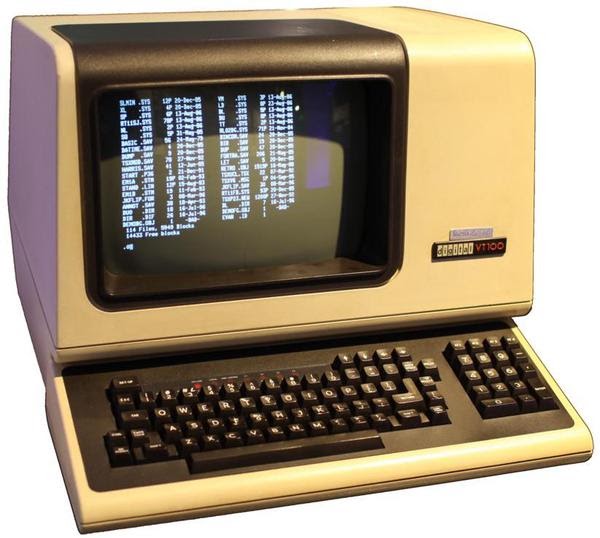
The DEC VT100, introduced in 1978 with an 80×24 display, became enormously popular with over one million units sold, further reinforcing the 80×24 standard in the ASCII terminal market. However, this success built upon the foundation established by IBM’s earlier dominance rather than creating an independent standard.
Today’s computing environment reflects this historical split, with terminal applications typically defaulting to either 80×24 or 80×25 dimensions depending on their heritage – Unix-based systems often favoring the terminal standard of 80×24, while PC-based environments commonly using the 80×25 format established by the IBM PC.