Scientists Discover How Magnetars Use Twisted Spacetime to Create Universe’s Brightest Explosions
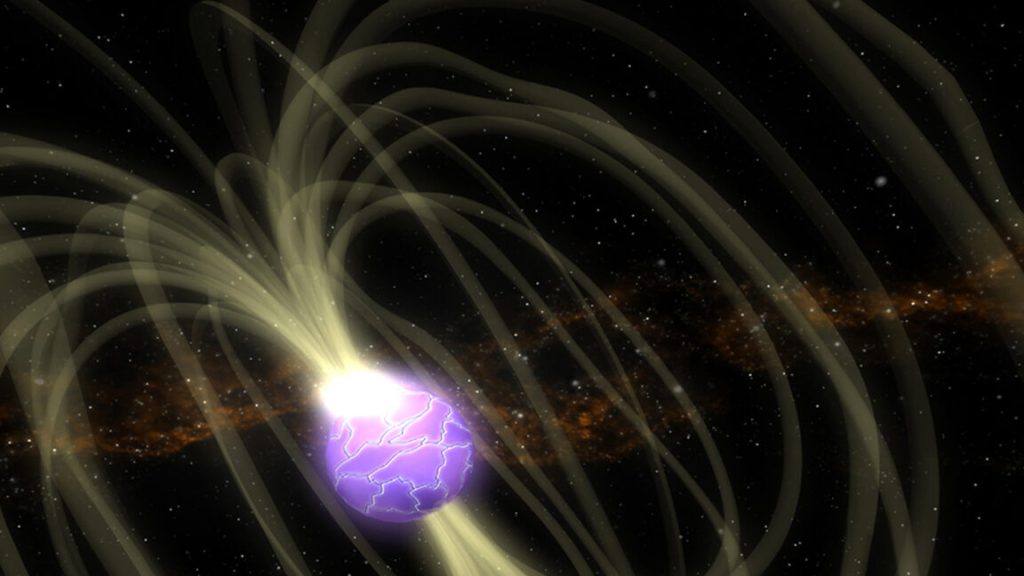
Among the most spectacular phenomena in the cosmos are Type I superluminous supernovae, representing some of the most brilliant explosions known to science. According to Joseph Farah, an astrophysicist at the University of California, Santa Barbara, these cosmic events rank among the most luminous occurrences in the universe. For decades, researchers have struggled to comprehend the mechanisms behind such extraordinarily powerful stellar explosions. Recent findings suggest scientists may have finally uncovered the answer.
Research conducted by Farah and his team indicates these extraordinary events are likely driven by magnetars – rapidly rotating neutron stars that distort the fabric of space and time in their immediate vicinity.
Understanding the Energy Source
Magnetars have long been considered prime candidates for powering superluminous supernovae. The prevailing hypothesis suggests these intensely magnetized stellar remnants form from the collapsed core of the original star and release energy through magnetic dipole radiation. As Farah describes it, this core represents approximately one solar mass compressed into an area the size of a metropolitan area. As the magnetar’s rotation gradually decreases, it transfers its rotational energy to the expanding stellar debris, illuminating the surrounding material.
However, this theoretical framework failed to fully account for astronomical observations. Traditional magnetar models predicted that supernova light curves should exhibit rapid initial brightening followed by smooth, gradual dimming as the neutron star loses rotational energy. Farah notes that according to these predictions, the light curve should display a simple rise and fall pattern. Yet actual observations of superluminous supernovae rarely show this smooth decline. Instead, astronomers detect irregular fluctuations, oscillations, and peculiar modulations that persist for months.
Previously, scientists attempted to modify the magnetar theory to match observations. Some proposed that expanding debris collided with irregular shells of material previously ejected by the star, while others suggested the magnetar itself produced random, violent energy bursts. These explanations, however, required extremely specific and precisely calibrated parameters to align with telescopic observations.
A Breakthrough Discovery
The resolution to this puzzling behavior emerged when the Liverpool Gravitational Wave Optical Transient Observer collaboration identified an object designated SN 2024afav on December 12, 2024. Initially, this object appeared to be a typical superluminous supernova, displaying characteristic brightness and irregular light curve variations similar to other objects in this category. However, continued observation revealed unprecedented behavior: the object began exhibiting a chirping pattern.
In physics terminology, a chirp describes a signal whose frequency steadily increases over time. For SN 2024afav, the emissions showed periodic fluctuations with progressively shorter intervals between peaks. After observing a second and third peak with intervals reduced by approximately 35 percent, Farah’s team realized they could predict future peak timing.
The researchers adjusted their observation schedule and directed their instruments toward SN 2024afav, successfully detecting the fourth peak exactly when predicted. The fifth peak allowed scientists to refine their calculations, determining the period reduction to be approximately 29 percent.
The team’s ability to accurately predict these fluctuations fundamentally challenged existing magnetar models. While occasional irregular variations could be attributed to supernova material colliding with gas clouds, this explanation couldn’t account for precisely timed, sinusoidal modulations with steadily decreasing periods. Random cosmic debris simply doesn’t behave in such predictable patterns.
The Frame-Dragging Solution
Farah’s team developed a new theoretical framework to explain this behavior, incorporating the Lense-Thirring effect, also known as frame-dragging. This phenomenon, predicted by General Relativity, describes how massive spinning objects slightly drag surrounding spacetime along with their rotation. While this effect had never been observed around magnetars previously, applying this mechanism perfectly matched the observed behavior.
The team hypothesized that the flickering patterns in superluminous supernovae result from a newborn magnetar’s extreme gravitational field dragging spacetime along as it spins.
To visualize this concept, imagine a spinning bowling ball in thick molasses. As the ball rotates, friction drags the viscous fluid along, creating a swirling vortex. According to Einstein’s General Relativity, mass and energy can warp spacetime, so a sufficiently massive object spinning rapidly will drag spacetime in a similar manner. While this effect is negligible around Earth, a newborn magnetar – far more massive and spinning hundreds of times per second – creates violent, twisting spacetime distortions.
When the progenitor star exploded to create SN 2024afav, not all material was ejected uniformly. Some stellar material fell back toward the newborn magnetar, forming a small accretion disk around it. Critically, this disk was misaligned relative to the magnetar’s rotational axis. Within the aggressively twisted spacetime, the Lense-Thirring effect caused the entire tilted disk to wobble or precess around the magnetar’s spin axis, similar to a slowing spinning top.
This wobbling misaligned disk functioned like a cosmic lampshade, periodically blocking, reflecting, or redirecting intense radiation and jets emanating from the central magnetar. High-energy photons from the magnetar had to penetrate the expanding supernova debris, being converted to optical light and diffusing outward over approximately 15 days. From Earth’s perspective, this wobbling disk created rhythmic brightness fluctuations in the superluminous supernova.
Explaining the Chirping Pattern
After explaining the brightness fluctuations through the wobbling disk model, the team addressed why the signal exhibited chirping behavior. Their proposed solution involves the disk’s dynamic environment. The accretion disk’s size isn’t constant but is determined by the balance between inward ram pressure from infalling matter and outward radiation pressure from the magnetar. Over time, as the exploding star depletes its fallback material, the disk’s accretion rate decreases. With reduced inward pressure, the disk loses equilibrium and begins contracting, falling toward the magnetar. Proximity to the spinning magnetar intensifies the Lense-Thirring effect.
As the accretion disk shrinks and falls deeper into the gravitational well, the twisted spacetime accelerates its rotation. Farah compares this to a figure skater pulling in their arms to spin faster. Consequently, precession accelerates, wobbles become more rapid, and the light curve chirps.
By analyzing the chirping patterns, Farah’s team could reverse-engineer the magnetar’s properties powering SN 2024afav. They determined its spin period to be 4.2 milliseconds and calculated its extraordinarily powerful magnetic field. Remarkably, the magnetar properties derived solely from chirping analysis matched those required to power the superluminous supernova’s overall brightness. The engine driving the main explosion possessed exactly the right characteristics to produce the observed wobbling behavior.
Expanding the Model
The research team examined archival data from other irregular superluminous supernovae, including SN 2018kyt, SN 2019unb, and SN 2021mkr. Their magnetar plus Lense-Thirring model successfully explained modulations in these events as well. An entire class of stellar explosions that previously required multiple conflicting physical explanations could now be unified under a single, elegant theoretical framework.
However, this model still contains numerous unanswered questions. Farah acknowledges uncertainties in how accretion disks form, how they modulate magnetar light, how that light reaches the ejecta, and finally how it reaches observers. For each process, multiple mechanisms are possible, and the team selected their best estimates.
To fully understand these phenomena, Farah emphasizes the need to discover more objects similar to SN 2024afav. This should become feasible with new observatories like the Vera C. Rubin Observatory in Chile coming online. The Rubin Observatory is expected to discover dozens of these chirping supernovae, enabling researchers to test their models against numerous different objects. This represents just the beginning of understanding these remarkable cosmic phenomena.