
Desert Fossil Discovery Reveals Ancient Ocean Secrets Through Mathematical Analysis
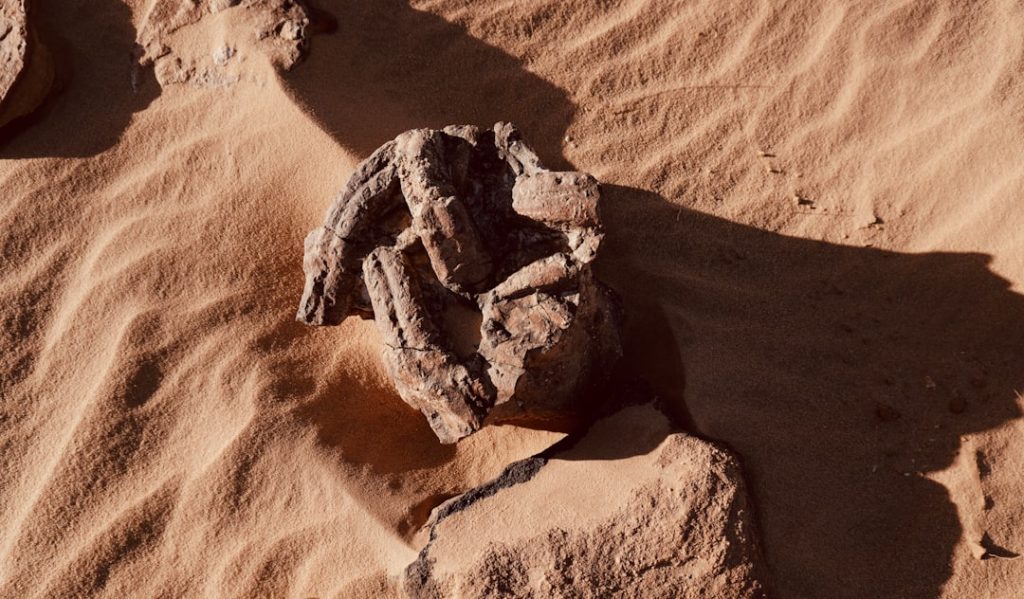
What started as a curious discovery in Saudi Arabia’s Alghat desert has evolved into a fascinating exploration of ancient marine life and cutting-edge shape analysis. The discovery of a perfectly preserved shell fossil, located hundreds of kilometers from any coastline, offers compelling evidence of the Arabian Peninsula’s submerged past.
This find is particularly intriguing because it challenges our immediate understanding of desert landscapes. Finding marine fossils in arid regions shouldn’t surprise us—it’s actually quite common—but it never fails to capture the imagination. For geology enthusiasts and amateur paleontologists, such discoveries serve as tangible connections to Earth’s dynamic history.
Geological Context and Ancient Seas
The presence of carbonate rocks, marine fossils, and sedimentary structures throughout the Alghat region provides substantial evidence that portions of the Arabian Peninsula were submerged beneath ancient seas during the late Jurassic period, approximately 150 million years ago. This geological reality transforms our perception of current desert landscapes.
What makes this discovery particularly valuable is how it demonstrates the dramatic environmental changes our planet has undergone. For students and educators, these fossils serve as perfect teaching tools about geological time scales and environmental transformation. However, casual observers might find the technical aspects overwhelming without proper context.
Innovative Approach to Fossil Identification
Rather than relying on traditional paleontological methods, this investigation employed a novel mathematical approach to identify the fossil specimen. The methodology focused exclusively on morphological analysis—essentially using shape as the primary identification tool.
This approach has obvious limitations that any serious paleontologist would immediately recognize. Shape alone cannot definitively determine lineage, as convergent evolution often produces similar forms in unrelated species. However, for amateur researchers or those without access to professional paleontological resources, this method offers an accessible entry point into fossil analysis.

The process involved three key steps: mathematically representing shell shapes, defining distance metrics between different forms, and mapping the dimensional space of possible shell configurations.
Mathematical Modeling of Natural Forms
The analysis utilized a comprehensive dataset containing 7,894 different species and 59,244 shell images. Each specimen underwent rigorous normalization to eliminate variables like rotation, scale, and translation that could skew results.
This normalization process reveals both the strengths and weaknesses of automated analysis systems. While mathematically elegant, the approach struggles with the same challenges that plague computer vision generally—accounting for natural variation and orientation differences. Professional researchers would likely find these limitations concerning, while data science enthusiasts might appreciate the creative problem-solving involved.
Each shell was represented as 256 coordinate points along its contour, creating a 256-dimensional mathematical representation. This level of detail captures subtle shape variations that human observation might miss, though it also introduces computational complexity that may not be justified for basic identification purposes.
Dimensionality Reduction and Pattern Recognition
Principal Component Analysis (PCA) proved instrumental in reducing the 256-dimensional data to manageable proportions while preserving essential shape characteristics. The analysis retained 56.50% of variance using just the first principal component, and 67.25% using two components.
This finding has broader implications for how we understand natural form variation. The fact that shell diversity can be largely captured by just two mathematical dimensions suggests underlying constraints in biological development that would fascinate evolutionary biologists but might bore those seeking straightforward identification results.

The first principal component appears to represent shell ‘pointiness,’ while the second relates to symmetry or mass distribution. These insights prove valuable for understanding morphological trends across species, though they offer limited practical value for field identification.
Results and Evolutionary Implications
The analysis identified Sphincterochila candidissima as the closest morphological match to the Alghat fossil. However, this species emerged only 38 million years ago—far more recent than the Jurassic-age fossil in question.
This temporal disconnect highlights exactly why professional paleontologists emphasize stratigraphic context and detailed morphological analysis over simple shape matching. The similarity likely represents convergent evolution, where unrelated species develop comparable forms due to similar environmental pressures.
For researchers interested in evolutionary patterns, this convergence offers valuable insights into how environmental constraints shape biological form. For fossil collectors seeking definitive species identification, however, these results demonstrate the limitations of purely morphological approaches.
Broader Implications and Applications
This investigation demonstrates how modern computational tools can democratize scientific inquiry, allowing curious individuals to conduct sophisticated analyses previously restricted to academic institutions. The approach would particularly benefit amateur paleontologists, geology students, and anyone interested in quantitative approaches to natural history.
However, professional researchers should view these methods as supplementary rather than replacement tools for established paleontological techniques. The mathematical elegance shouldn’t obscure the fundamental importance of geological context, stratigraphic relationships, and expert interpretation in fossil identification.
The discovery ultimately serves multiple audiences: it satisfies scientific curiosity about ancient environments, demonstrates innovative analytical approaches, and provides tangible evidence of our planet’s dynamic geological history. Whether you’re a weekend fossil hunter or a serious researcher, findings like these remind us that remarkable discoveries often emerge from the intersection of curiosity, accessibility, and technological capability.
Photo by Azzedine Rouichi on Unsplash
Photo by Anjas A V on Unsplash
Photo by Joseph Corl on Unsplash